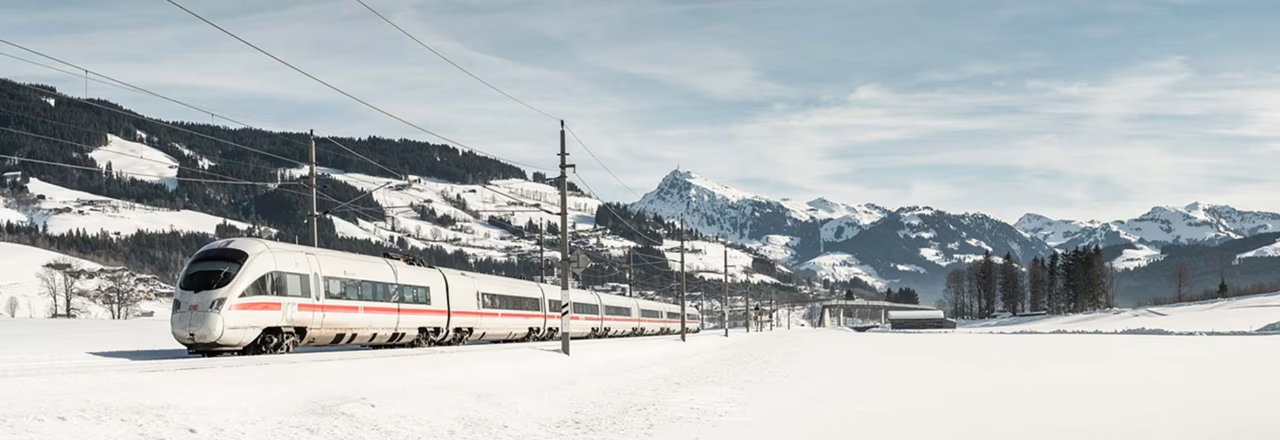
Mit dem Zug statt
mit dem Auto?
Wir wissen, wie schwer sich das anfühlen kann.
By train instead of by car?
We know how difficult that can feel
We all know the situation:
Skis, boots, helmet, bag – everything packed into the trunk. Favorite music on, coffee in the cup holder, off toward the mountains. The car feels comfortable. Familiar. Easy.
And that’s exactly why it’s often so hard to even think about taking the train instead.
But take a moment—and follow that thought just a little further.
The journey matters more than many people think
What surprises many people:
The largest share of the climate emissions from a winter holiday is not created on the slopes, but on the way there.
Travel to and from the destination often accounts for more emissions than accommodation, lift operations, or equipment.
At the same time, this is where one of the biggest levers lies—because the differences between modes of transport are significant.
A look at the numbers (fair and transparent)
According to common calculations (e.g., from the German Environment Agency and Deutsche Bahn):
Car (average passenger car, one person)
approx. 150–170 g CO₂ per passenger kilometerTrain (electric long-distance rail)
approx. 5–20 g CO₂ per passenger kilometer
(depending on the connection and electricity mix)
What does that mean in practice?
Example: winter trip from Munich to the Alpine region
(approx. 150 km one way)
Car (driving alone)
→ around 45–50 kg CO₂ for a round trip per personTrain
→ around 4–6 kg CO₂ for a round trip per person
Savings: about 40 kg CO₂—from just a single trip.
If several people travel together in a car, the emissions are distributed accordingly. In practice, however, it often turns out that even well-occupied cars still produce more emissions than a train journey.
And how do I get from the station to the ski resort?
A lot has changed in recent years.
Many winter sports regions, organizers, and associations (including partners of Zukunft Wintersport) now rely on:
Ski buses directly from the train station to the ski area
Public transport integration in guest cards or event tickets
Clear information about car-free travel options
Sustainable mobility shouldn’t be complicated—it should simply work.
And honestly:
Not having to drive while the winter landscape passes by outside often feels more relaxing than you might think—especially when you could read a book or chat with friends instead of sitting in traffic.
Planning can also be surprisingly simple:
With our ChatGPT prompt suggestions for travel planning and specific train-bus connections, you can organize your trip in no time. The prompts are listed further down in the article.
Making the impact visible
One reason climate-friendly choices can sometimes feel abstract is that their effect isn’t immediately visible.
This is where CO₂ calculators help by providing concrete numbers:
Deutsche Bahn shows for each connection how much CO₂ is saved compared to traveling by car:
https://co2kompass.bahn.de/enThe International Ski and Snowboard Federation (FIS) also refers to such calculations in its sustainability context:
https://www.fis-ski.com/inside-fis/fis-future/sustainability/fis-co2-calculator
A good feeling becomes a measurable impact.
Not perfection—but a start
No one expects every winter trip from now on to be planned in the most climate-friendly way possible.
But:
If a single decision—car or train—can already save several dozen kilograms of CO₂, that’s a step that matters.
Maybe not every time.
But on the next trip.
Or the one after that.
Winter sports depend on snow, cold temperatures, and reliable winters.
And that’s exactly why it’s worth occasionally rethinking how we get there.
Try it yourself and share it – because planning can be simple
The following prompts can help you research suitable offers, discover new possibilities, and plan your next trip to the mountains—without having to manage 20 open browser tabs.
Prompt 1: Plan a sustainable journey
“Plan a climate-friendly winter trip from [starting location] to [destination], preferably by train and bus. Also show options for the last mile from the train station to the ski resort.”
Prompt 2: Find rail offers
“Which Deutsche Bahn offers are suitable for a winter trip from [starting location] to the Alps, including weekend or group options?”
Prompt 3: Car-free winter sports day
“Create a car-free winter sports day plan starting from [starting point] using train and ski buses with as few transfers as possible.”
Prompt 4: Compare car vs. train
“Compare the CO₂ emissions of a car trip and a train journey from [starting location] to [ski resort] and explain the differences clearly.”
Best Practice: Sustainable access to the slopes
Whether from Munich, Salzburg, or Chur:
Numerous small and medium-sized ski areas can now be reached directly by train and ski bus—for example Lenggries, Werfenweng, or Arosa.
Winter sports without a car are therefore no longer the exception, but already common practice in many places.
From Munich
Garmisch-Partenkirchen
🚆 Direct train from Munich Central Station
🚌 Ski buses from the station
🎿 Hausberg, Kreuzeck/Alpspitze, Zugspitze
➡️ A classic for day trips and weekend visitors
Mittenwald
🚆 Train Munich–Mittenwald
🚌 Ski bus from the station
🎿 Karwendel ski areas
➡️ Compact, quiet, and very easy without a car
Lenggries
🚆 BRB train from Munich
🚌 Ski bus toward Brauneck
🎿 Brauneck
➡️ A popular example of a car-free day trip
Oberstdorf
🚆 Direct connection from Munich
🚌 Ski buses from the station
🎿 Nebelhorn, Fellhorn/Kanzelwand, Söllereck
➡️ End-of-the-line station = perfect entry without a car
From Salzburg: Train + bus as the standard solution
Werfenweng
🚆 Train to Werfen
🚌 Ski bus to the village & ski area
🎿 Werfenweng
➡️ Part of the “Alpine Pearls” network, strongly focused on car-free tourism
Bad Hofgastein
🚆 Bad Hofgastein station
🚌 Ski bus directly to the ski area
🎿 Gastein Valley
➡️ Excellent bus network, also for longer stays
Zell am See
🚆 Zell am See station
🚌 Ski buses within the town
🎿 Schmittenhöhe
➡️ Station, accommodation, and ski area close together
Radstadt
🚆 Radstadt station
🚌 Ski bus into Ski amadé
🎿 Radstadt–Altenmarkt
➡️ A good example of regional connectivity
From Chur: Switzerland as a model – rail as the backbone
Lenzerheide
🚆 Chur station
🚌 PostBus directly to the ski area
🎿 Arosa Lenzerheide
➡️ Frequent service, very reliable
Arosa
🚆 Rhaetian Railway from Chur
🚞 Directly into the town center
🎿 Arosa
➡️ The train practically ends at the slopes
Flims Laax Falera
🚆 Chur
🚌 PostBus to the ski area
🎿 LAAX
➡️ Large destination—still easily reachable without a car
Davos
🚆 Rhaetian Railway
🚌 Local buses & mountain lifts
🎿 Parsenn, Jakobshorn, Rinerhorn
➡️ Multiple ski areas, fully connected by public transport